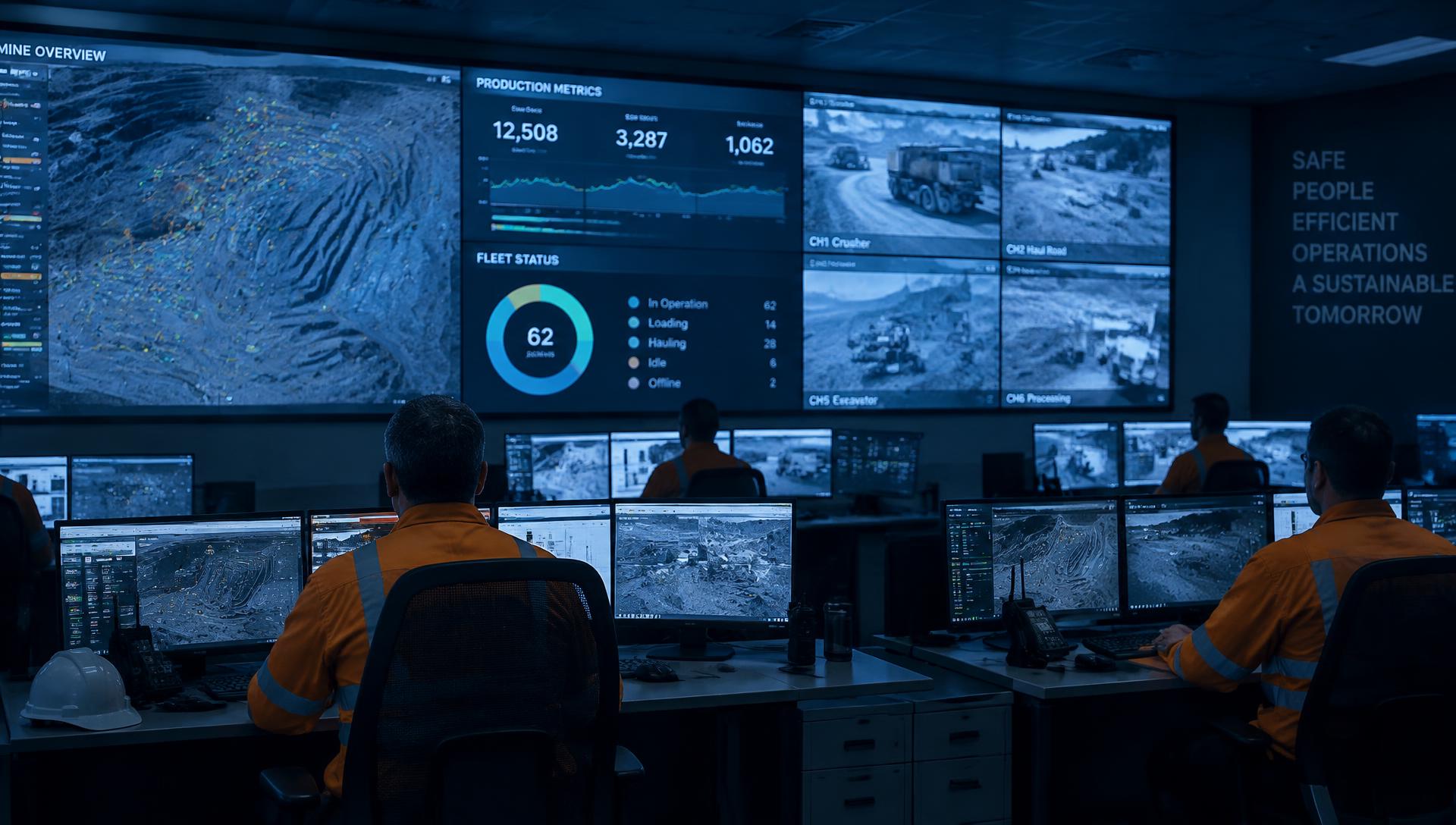
Your mine keeps running when the network doesn't.
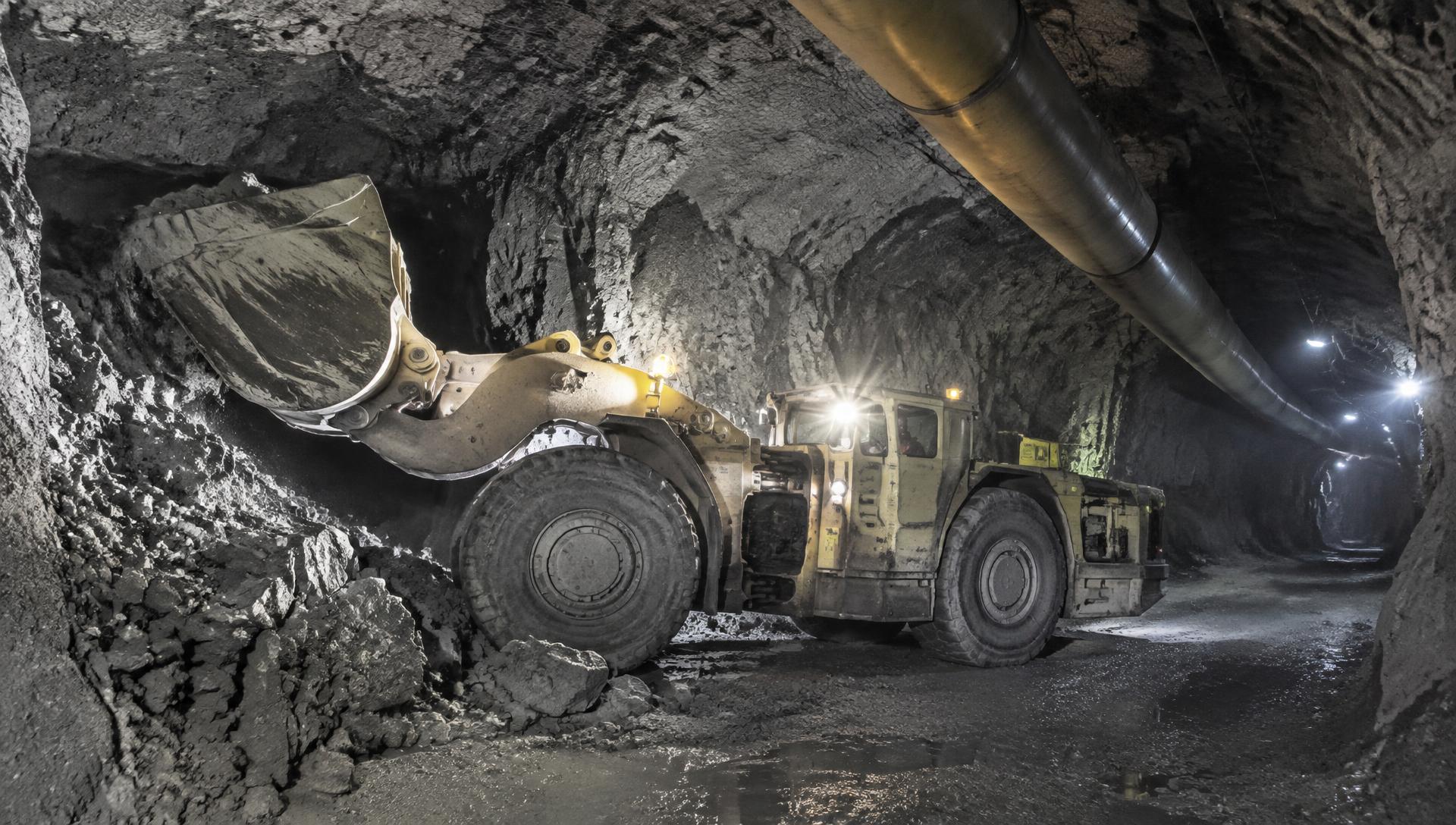
Underground. Remote. Disconnected. The environments where mining happens are exactly where cloud-dependent control fails. Helin runs zone safety, equipment monitoring, and operational data at the asset, no link required.
Proven in some of the harshest operational environments in industry.
- Boskalis100+ vessels, live in under two weeks
- Sunrock150 solar sites steered against live market prices
- BPcamera to control action in under 150ms
- Noble20+ rigs on one fleet-wide deployment
At a glance
- Unplanned equipment failure in mining costs $180,000 per hour on average
- Edge-resident fault detection catches developing failures 30‑50 days earlier than threshold monitoring
- Zone intrusion response fires in under 150ms — at the asset, without a cloud round-trip
- One platform covers equipment health, personnel safety, and operational data across every site
- Deployable in remote and underground environments without reliable WAN
The fault was detectable. The network wasn't.
Most mining downtime doesn't arrive without warning. It arrives after weeks of ignored data — because the system that should have caught it was waiting for a cloud connection that wasn't there.
- Equipment fails with no warning — because the warning never arrived
- Haul trucks, SAG mills, crushers, and conveyors generate detectable failure signatures days to weeks before breakdown. Bearing vibration anomalies. Hydraulic pressure shifts. Motor current irregularities. The data exists. But a cloud-dependent system on intermittent WAN can't process it continuously. Underground, it can't process it at all. The failure window closes before anyone acts.
- People work in hazardous zones with no real-time visibility
- Restricted zones around automated equipment, blast exclusion areas, and confined entry points require response times measured in milliseconds, not minutes. A safety alert that routes through the cloud arrives after the person has already reached the hazard.
- You have data from every asset. You have visibility across none of them.
- Fragmented systems. Sensors that log but don't communicate. Operational data that sits on-site, unread, until something goes wrong. Getting a fleet-level view of asset health requires manual aggregation — which means it's always out of date.
Annual downtime exposure
Annual downtime exposure
$21,600,000
Heavy assets × average downtime hours per year per asset × cost per downtime hour.
Illustrative projection based on industry data and your inputs.
8–12%
Conservative maintenance cost reduction range with edge-resident predictive monitoring.
Illustrative projection based on industry data, not a guaranteed outcome. This range applies to maintenance costs, not the downtime exposure above.
Where edge control changes mining economics
Each use case runs on the same platform. Add one, the infrastructure is already there for the next.
Everything you're managing separately, running as one.
Key features by capability
- Edge control01
Edge runtime
Control logic executes at the asset. Applications run locally, with or without a cloud connection.
- Edge control02
Hardware-agnostic deployment
Runs on existing edge hardware across surface and underground sites. No vendor lock-in, no rip-and-replace.
- Edge control03
Edge buffering
No data lost when connectivity drops. Data queues locally and transmits when the link returns.
- Edge control04
OTA updates
Software updates reach every site in the fleet without a site visit. Staged rollout — tested before it reaches production.
- Edge control05
Fleet and device management
Provision, configure, monitor, and patch every edge node from one console. No engineer on-site for routine management.
What changes when the architecture is right
Your operations don't stop when the network does
Underground. Remote. Intermittent satellite. Mining happens in the places where cloud-dependent control breaks down. Control logic, safety responses, and equipment monitoring run at the asset, continuously, regardless of connectivity. When the link drops, production continues. When the link returns, data syncs.
Proof: Sunrock runs 150 solar farms on the same architecture. Sites that previously couldn't be steered in real time now execute curtailment decisions locally, before a cloud round-trip would complete. The mining parallel is direct: edge-resident control at every asset, running whether or not the network is.
Security built in. Not bolted on.
A mine running dozens of sites accumulates thousands of networked devices over years. Sensors, controllers, gateways, HMIs. Most were connected without formal identity enrollment. Certificate-based device identity, zero-trust access governance, and auditable update logs are in the Helin runtime from provisioning. NIS2 and IEC 62443 compliance is a structural property of the platform, not a pre-audit project.
Proof: Boskalis deployed real-time compliance governance across 100+ vessels on the same architecture.
AI that acts. Not AI that advises.
The gap between a sensor alert and a control action is where incidents happen and production is lost. A zone intrusion response that routes through the cloud arrives after the hazard has been reached. An equipment fault flagged to a dashboard waits for a human to act. Helin closes that loop at the asset. The model runs locally, detects the condition, and triggers the response in under 150ms.
Proof: Red Zone Manager detects a zone intrusion and fires a physical response in under 150ms across Noble's offshore fleet. No cloud hop. Same architecture, same response time, any environment.
Your expertise, running at the edge
Your teams know your equipment, your haul routes, your blast exclusion logic, and your maintenance procedures. Helin provides the runtime, security, device management, and deployment pipelines so the applications your teams build run consistently across every site. Build it once. Operate it everywhere.
If your sites lose connectivity, does your operation lose control?
Talk to someone who has deployed edge control in remote and disconnected industrial environments. Bring your architecture. We'll show you where the gaps are.
Cloud-dependent vs. edge-resident: what the difference looks like underground
| Capability | Helin edge-resident | Cloud-dependent |
|---|---|---|
| Connectivity required | No. Runs offline, syncs when available. | Yes. Degraded or failed link stops operations. |
| Control loop latency | Under 150ms at the asset | 500–800ms or more over satellite |
| Fault detection | Continuous, regardless of connectivity | Interrupted when WAN drops |
| Safety response | Fires locally, no round-trip | Cloud round-trip required |
| OTA updates | Secure OTA across all sites | Manual or unreliable on degraded links |
| Device identity | Certificate-based, X.509 / TPM 2.0 | Manual or absent |
| Compliance posture | Auditable, automated, continuous | Manual assembly before each audit |
Specifications
| Deployment model | On-premises edge hardware or customer-supplied compute. No cloud dependency on control loop. |
|---|---|
| Supported protocols | OPC UA, Modbus, CAN bus, MQTT, NMEA |
| Hardware compatibility | Runs on any Linux-capable hardware. No proprietary hardware required. |
| Security architecture | X.509 / TPM 2.0 device identity, TLS encrypted communications, zero-trust access governance |
| Update governance | OTA updates with central version tracking, rollback, and confirmation logging |
| Control loop latency | Under 150ms sensor to action |
| Compliance coverage | NIS2, IEC 62443 |
| Connectivity | Private 4G/5G, radio, satellite, or no WAN. Offline-capable. |
| Hardware environment | [ATEX/IECEx — confirm certification status before publish] |
Frequently asked questions
What this is not
Not a cloud analytics platform
There is no cloud dependency for control decisions.
Not a safety system
It provides risk visibility, zone monitoring, and automated response capabilities. It is not certified as a safety-instrumented system.
Not a replacement for your OT stack
PLCs, SCADA, and field devices stay in place. Helin is the application layer that connects, manages, and adds intelligence on top.
Not a pilot product
The same platform runs offshore drilling, maritime fleet operations, and renewable energy sites at scale. Mining is a new vertical. The architecture is not.
Not built for single-site or low-complexity operations
The platform is designed for distributed, multi-site, safety-critical environments.
Edge intelligence, once a month.
Field notes from industrial operations running control at the asset: deployment patterns, compliance changes, and what we learn on site. No product marketing.