
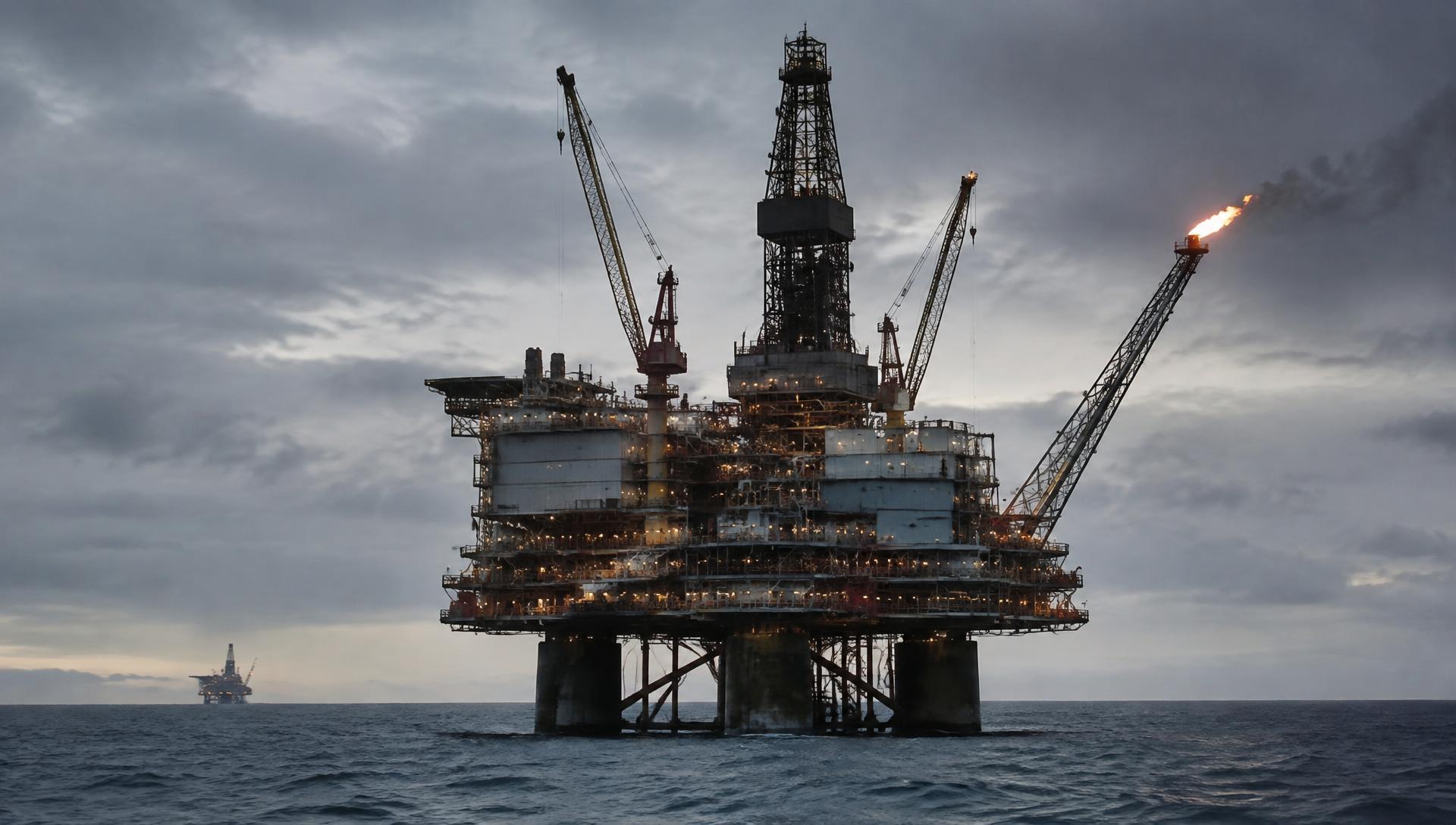
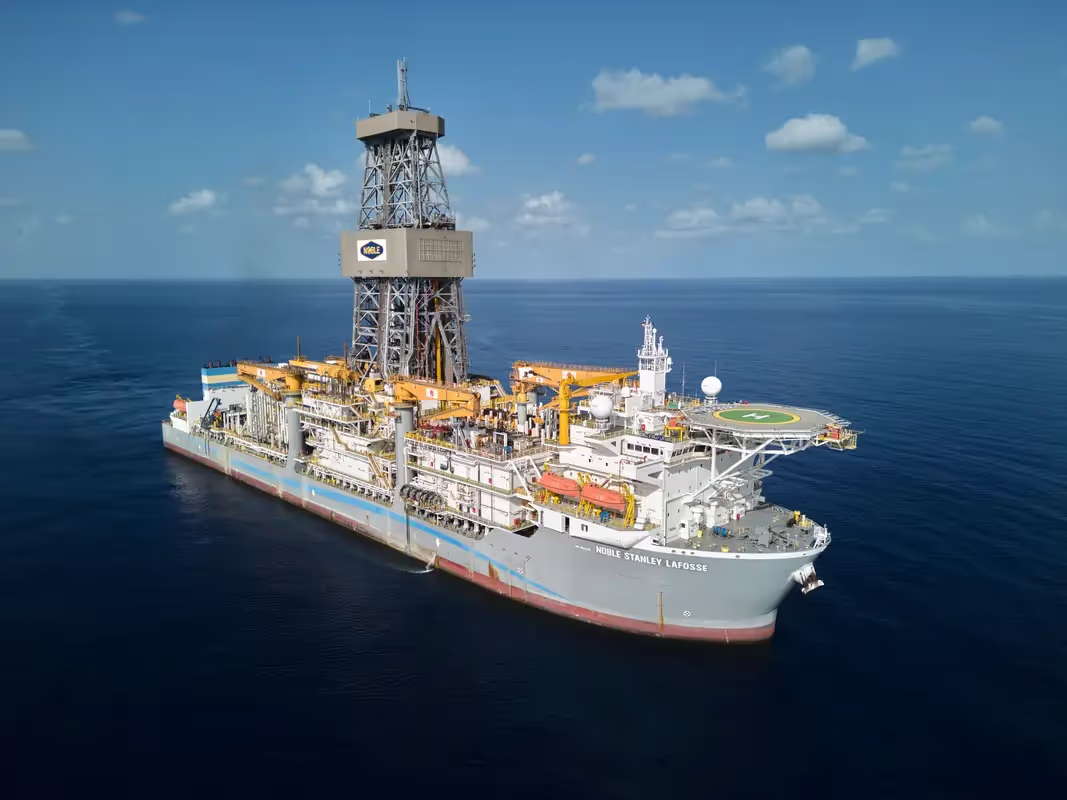
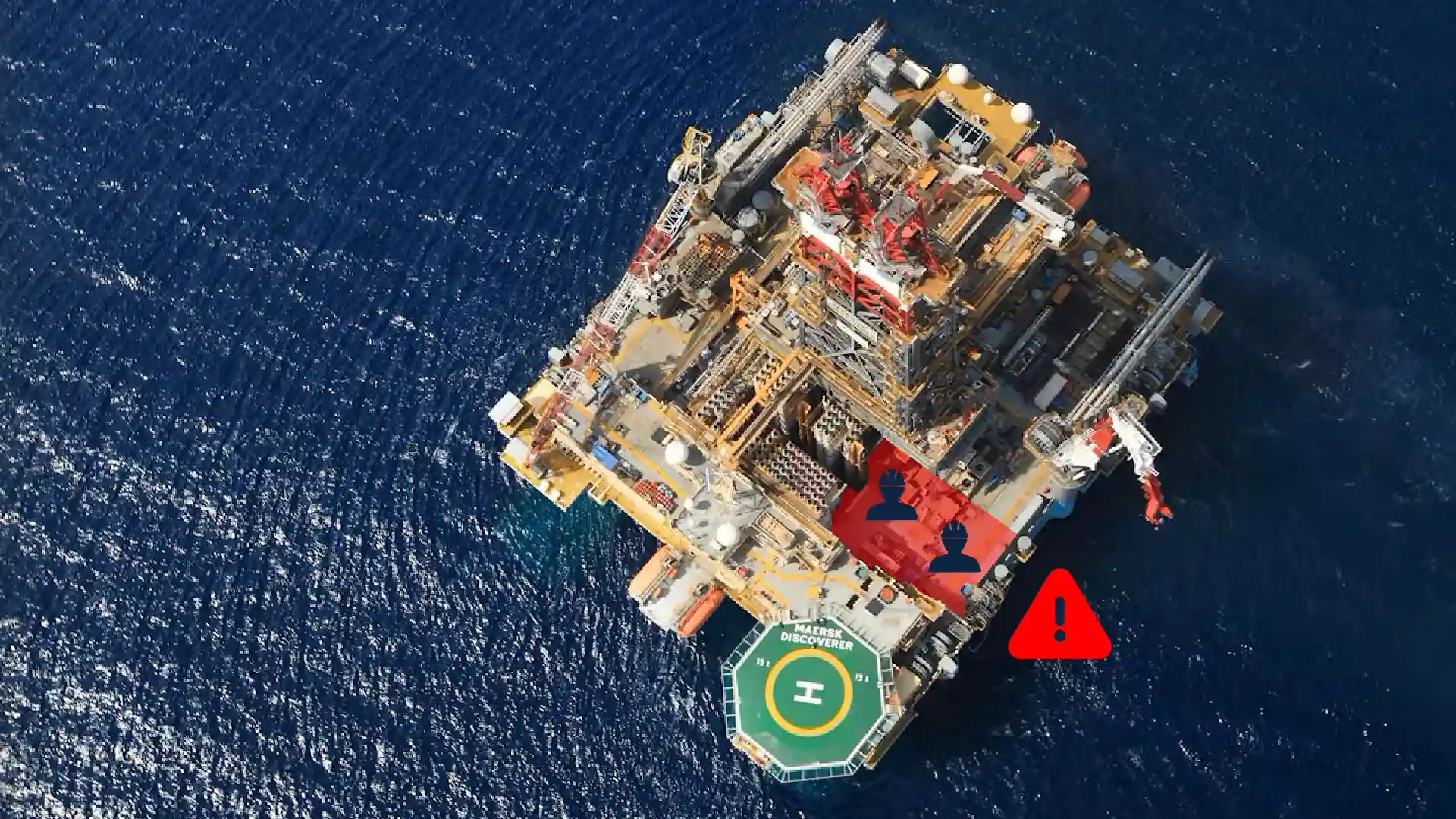
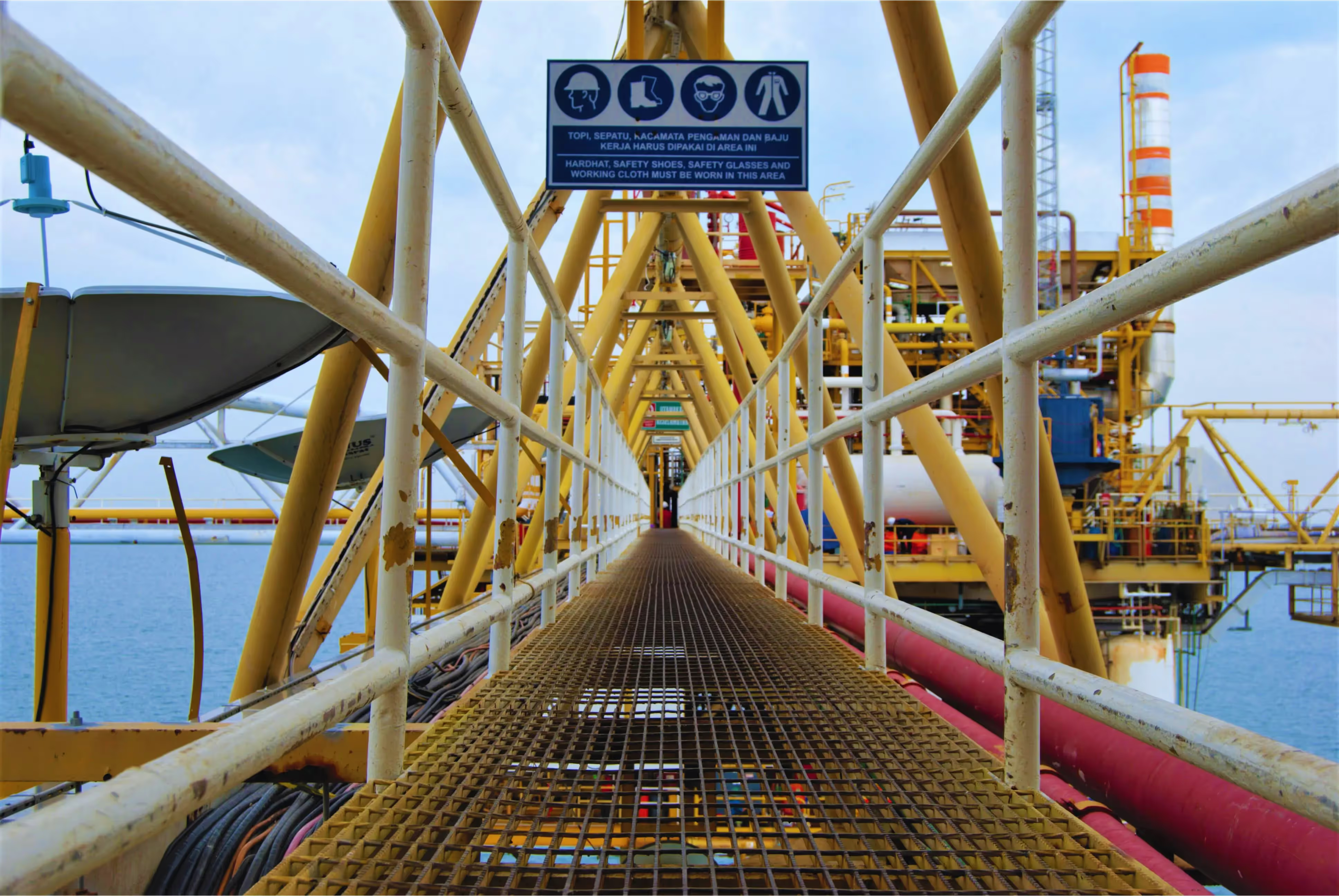
Fewer people in the red zone. Every shift, every rig.
Red zone exposure is measurable. On one rig, job-by-design override ran at 90% of the time. Five months later it was 10%. Peak drill floor manning during RIH/POOH halved from 12 people to 6. The system that did it runs on 40+ rigs globally.
- Noble40+ rigs live in three months
- BPcamera to control action in under 150ms
- 400+sites and vessels in production
- 30 daystypical time to first value
At a glance
- Helin is the secure edge application engine for offshore oil and gas operations. Red zone monitoring, PPE detection, stabbing guidance, coil monitoring, and drilling data all run on one edge node per rig.
- Noble runs the platform across 40+ rigs. NGT2 phase one was live in three weeks.
- 150ms end-to-end latency, camera to alarm, no cloud in the control loop. 33% reduction in normalized red zone exposure on RIH/POOH, measured over five months.
- 1,500 to 2,000 person-hours out of active red zones per rig per year at 25% exposure reduction.
- Certificate-based device identity and zero-trust access on every node, meeting NIS2 and EU Cyber Resilience Act requirements by design.
Where exposure accumulates on a drilling operation
Every rig has cameras. Most still have the same exposure problems.
- Blind spots don't close themselves
- Equipment blocks the driller's sightline to large parts of the floor. Attention drops across a 12-hour shift. Dropped objects account for 80 to 95% of red zone incidents, and they don't fall straight down. On one rig, job-by-design override was running at 90% of the time before the system was properly embedded.
- Incident logs aren't exposure data
- Most rigs record what happened. Few track how many person-hours crews spent in active red zones, broken down by operation and activity. Without that, after-action reviews run on memory. The same high-exposure activities repeat, on every rig, every rotation.
- What works on the best rig stays there
- A rig superintendent across four jack-ups and two floaters has no way to benchmark exposure fleet-wide without a shared data layer. Improvements don't transfer. Each rig starts from scratch.
- A camera doesn't close the loop
- Offshore vision deployments produce alarm logs. Exposure doesn't move. Moving it requires monitoring data to feed weekly reviews, which reset job-by-design parameters, which change crew behavior, which gets tracked and benchmarked. That's a platform problem, not a camera problem.
- Ungoverned remote access is an attack surface
- Distributed rigs need remote oversight. But inconsistent device credentials and fragmented audit logs are among the most common OT security entry points. NIS2 for Energy requires certificate-based device identity and structured audit trails as architectural properties, not a compliance layer bolted on after the fact.
Estimate your exposure reduction
Enter your fleet size
Based on typical offshore drilling operations
Reference: 25–33% measured on live deployment
Person-hours removed from active red zones per year
—
Rigs × person-hours × reduction %
Reduction in peak drill floor manning
Reference: 12 to 6 people on RIH/POOH at 33% reduction
These figures use operational data from a live deployment across multiple rigs, measured from March to August 2026. Output is directional. Actual results depend on rig type, operations mix, and system embedding. Formulas and assumptions are shown above. This calculator outputs in operational units — person-hours and manning levels. Helin does not convert exposure reduction to a guaranteed financial outcome.
Choose what matters most on your operation.
Select a pillar, then open a card to see how it works.
Trusted by leading offshore operators
- BP
- Caspian Drilling Company
- Eni
- Noble Corporation
- Odfjell Drilling
- Petrobras
- Seadrill
- Shell
- Stena Drilling
- TotalEnergies
- Turan Drilling
- Valaris
- Vantage Drilling







Solutions running on the platform today
Select a pillar, then open a card to see what it does.
Noble, 40+ rigs, seven years
Noble runs a globally distributed fleet on bandwidth-limited links, with equipment from multiple OEMs. Helin Platform unifies the data and the applications across it: live MPD acquisition, automated MPD reporting, predictive maintenance on seals, Remote CCTV Manager on 20+ rigs, and Red Zone Manager on the drill floor.
An unplanned seal replacement used to cost more than half a day of downtime.
"When I was on a business trip I received a call that drilling at a rig was stopped due to an operational issue. Thanks to the Helin Platform I was able to watch the drilling operations live on NGT2 and provide real-time support."
Fewer people in the red zone.Starts with one conversation.
A 45-minute session with one of our experts. You describe the rig, the crew rotation, and where exposure runs highest. We show you what the data looks like after five months on a live deployment.
Architecture comparison
| Helin Platform | Point-solution camera system | Cloud-first approach | |
|---|---|---|---|
| Zone awareness | Conditional, adjusts to the active operation | Static, always active | Configurable, cloud-managed |
| Exposure measurement | Person-hours, occupancy, exposure rate per operation, crew, rig, fleet | Alarm count only | Cloud-side dashboards |
| Alert latency | Under 150ms, no cloud hop | Variable | 1 to 5+ seconds, link-dependent |
| Connectivity dependency | None for control decisions | Low | High |
| Fleet benchmarking | Built into Advanced Analytics | Not available | Requires separate BI layer |
| After-action review | Timestamped footage with zone state, alarm log, and occupancy data | Manual footage review | Cloud playback |
| Job-by-design integration | Core to the exposure reduction methodology | Not available | Not standard |
| NIS2 readiness | By design, certificate-based from provisioning | Not addressed | Partial, cloud side only |
| Adding a new rig | Deploy to existing platform | New camera install, new integration | New cloud pipeline |
Specifications
| End-to-end latency (camera to alarm) | ~150ms |
|---|---|
| AI inference latency | 40 to 50ms |
| Exposure reduction (measured, RIH/POOH) | 33% normalized, over 5 months |
| Person-hours reduction per rig per year | 1,500 to 2,000 at 25% reduction baseline |
| Job-by-design override reduction (measured) | 90% to 10% |
| Peak drill floor manning reduction (measured) | 12 to 6 people (RIH/POOH) |
| Stabbing guidance accuracy | Below 3mm, real-time |
| Video retention (default) | 30 days, configurable |
| Camera rating | ATEX/IECEx Zone 1 |
| Indicator light rating | ATEX Zone 1 |
| Detection method | Camera-based, anonymous |
| Zone behavior | Conditional, adjusts to active operation |
| Connectivity requirement for control decisions | None (edge-native) |
| Supported data protocols | OPC-UA, MQTT, Modbus, proprietary OEM |
| Device identity standard | X.509 certificates, TPM 2.0 |
| Remote access governance | Per-user, per-dataset, fully logged |
| Update deployment | Over-the-air, no site visit required |
| Rig types validated | Jack-up, floater/semi, ice-class drillship, land rig |
| Analytics metrics | Exposure Rate, Occupancy, Operations, Intrusions, Heatmap |
Frequently asked questions
What this is not
Not a classified safety system
Helin is not classified under IEC 61508 or SIL standards. It reduces risk exposure and makes it measurable. Your existing safety case stays in place.
Not a SCADA replacement
It runs alongside and above existing control systems.
Not a wearable or tag-based tracking system
Detection is camera-based and anonymous by design.
Not a cloud-dependent platform
If your requirement is a centralized cloud analytics layer with no edge component, this is the wrong product.
Not a one-time deployment vendor
The commercial model is a recurring platform license per node, with the expectation of adding applications and rigs over time.
Not a point solution for a single rig with no expansion plan
The value compounds with fleet scale.
Not a generic IoT platform adapted for offshore
The hardware is ATEX/IECEx rated. The latency figures come from production deployments on active drill floors.
No facial recognition or individual identification
If your use case requires knowing who specifically crossed a zone, this is not the right system.
No guaranteed financial outcome
Helin does not convert exposure reduction to a financial guarantee. The calculator outputs in operational units: person-hours removed, manning levels, exposure rates.
Edge intelligence, once a month.
Field notes from industrial operations running control at the asset: deployment patterns, compliance changes, and what we learn on site. No product marketing.