

Ten years ago, the idea that hackers would deliberately target renewable energy assets would have seemed unlikely. Today, cyber threats are no longer theoretical, they are a daily operational reality for asset owners and operators across the sector.
With regulations such as the Network and Information Security Directive 2 (NIS2) and the EU Cyber Resilience Act moving from policy to enforcement, cybersecurity is no longer optional. It is now a core part of operating renewable assets responsibly.
Why hackers care about your renewable assets
Think of your renewable assets like a smart home, but instead of controlling your thermostat, you're managing megawatts. Your wind turbines, solar inverters, and battery storage systems are all connected to the internet, sharing data and receiving commands. This connectivity is fantastic for efficiency, until someone uninvited decides to join the party.
Recent attacks on energy infrastructure across Europe have shown that renewable assets are not just targets for environmental activists with spray paint anymore. Cyber criminals see opportunities in:
- Disrupting power supply for ransom.
- Stealing operational data.
- Manipulating energy markets.
- Creating chaos for competitive advantage.
NIS2 and the Cyber Resilience Act: the new rules of the game
Remember when compliance meant checking boxes for environmental standards? Add cyber compliance to your list. NIS2 and the EU Cyber Resilience Act aren't suggestions, they are requirements that come with real teeth.
What this means for you:
- You are now classified as an "essential entity".
- You need to report cyber incidents within 24 hours.
- Regular risk assessments are mandatory.
- Non-compliance can cost up to €10 million or 2% of global turnover.
Five practical steps to strengthen your defenses
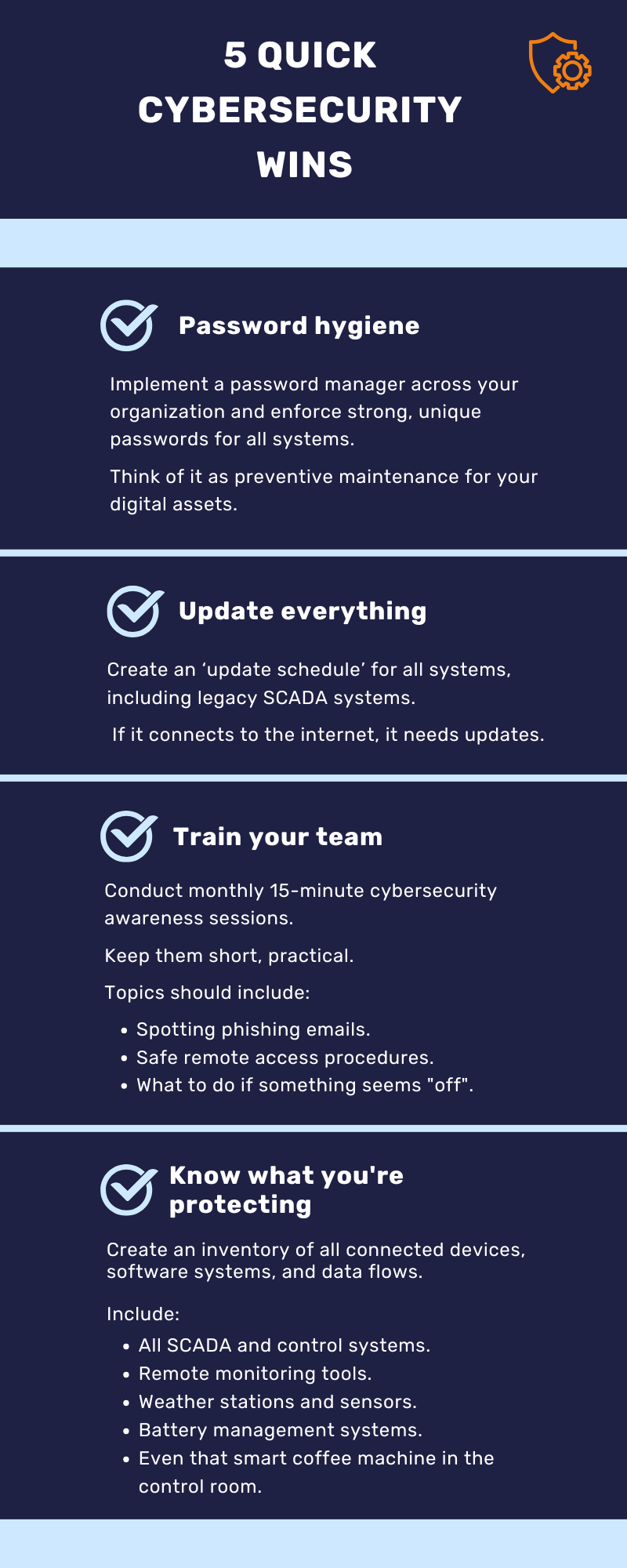
You don't need a security operations center on day one. These five moves remove most of the easy ways into a renewable portfolio.
Step 01
Fix your password and access hygiene
Replace shared and default credentials on inverters, loggers and gateways with unique accounts, enforce multi-factor authentication for anything reachable remotely, and remove access the moment a contractor leaves the project.
Step 02
Segment your networks
Keep OT networks separate from office IT and from the public internet. Apply both inbound and outbound filtering so a compromised device on one site cannot reach the rest of the portfolio.
Step 03
Take charge of firmware and patching
Know what is running on every asset, stage updates before they hit production, and make sure no vendor can push firmware to your sites without your change management process approving it first.
Step 04
Monitor continuously
Log and watch access, control commands and network activity in real time. You cannot report an incident within 24 hours if you only find out about it weeks later.
Step 05
Write and rehearse an incident response plan
Document who decides, who reports, and who calls the regulator. Then test it. A plan that has never been rehearsed will not survive its first real event.
Making compliance less painful with the right tools
Here is where modern platforms can turn compliance from a nightmare into maybe just a mild stress dream. A comprehensive asset management platform (like Helin) can help you:
- Centralize documentation: keep all your cybersecurity policies, risk assessments, and incident reports in one secure location.
- Automate compliance tracking: set reminders for required assessments and automatically log security events.
- Monitor asset security: track which systems have been updated, when maintenance was performed, and identify potential vulnerabilities.
- Streamline incident reporting: meet that 24-hour reporting requirement with pre-built templates and workflows.
- Manage supply chain security: keep track of all your vendors and their security certifications.
It serves as a practical, all-in-one tool for both operational and cybersecurity management, because managing renewable assets in 2026 also means protecting them.
Conclusion: security is the new sustainability
Just as you've invested in sustainable energy for the planet's future, investing in cybersecurity protects your business's future. The good news? You don't need to become a cybersecurity expert overnight. Start with these practical steps, leverage the right tools, and build security into your daily operations.
Remember: in the renewable energy sector, we're not just keeping the lights on, we're keeping them on safely and securely. And that's something worth protecting.
Talk to our experts
We'll help you assess your edge architecture, identify gaps, and secure your renewable operations, before someone else does.
By Martijn Handels